Red Clay That Does Not Swell: The Ground Under Winston-Salem Houses
People hear red clay and assume the ground is moving the house. Under Winston-Salem, USDA's soil survey says otherwise. The red clay here formed from rock weathering in place and is rated low for shrink-swell. When houses settle, the reasons are usually water, fill and the way a site was graded.
USDA's soil data rate about 85% of Forsyth County's major soil components low for shrink-swell. Fairview soils, the most extensive at about 29%, have a red clay subsoil formed from schist, gneiss and granite, and are described as well drained with low shrink-swell potential.
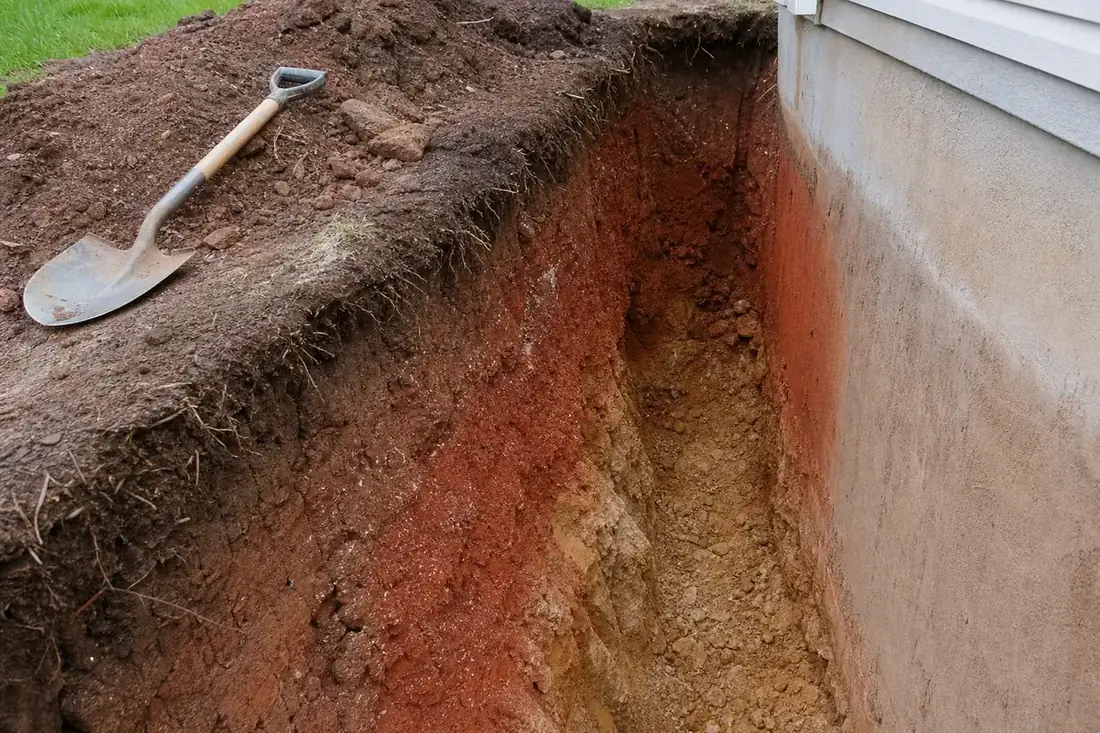
What soils are under Winston-Salem houses?
USDA's Soil Survey Geographic Database for Forsyth County maps Fairview soils on about 29% of the major soil components, Clifford on about 13%, and Tomlin and Poplar Forest on about 9% and 7%. Fairview and Clifford are Piedmont upland soils formed in residuum, rock weathered in place from mica schist, gneiss, granite and similar crystalline rock. The official description of Fairview gives a red clay subsoil starting about 10 inches down, firm and slightly sticky, with mica flakes, on slopes from 2% to 60%.
Why does this red clay not swell much?
The survey classes Fairview, Clifford and Pacolet clays as kaolinitic, and kaolinite clay takes up far less water than the clays that crack slab foundations elsewhere. USDA measures this as linear extensibility; about 85% of the county's major soil components rate low, under 3%, and only about 2% rate high. That is the main reason foundation trouble here tends to mean fewer heaved slabs and more settled piers and tired framing.
What makes ground settle here instead
- Fill. Lots leveled by pushing soil into low spots can settle for years under a footing. The survey maps urban land and disturbed soils across the city.
- Slopes. Fairview is mapped on slopes of 15% to 45% across about 16,000 acres, and Pacolet clay loam, moderately eroded, on similar slopes. Cut-and-fill pads on hillsides are common.
- Water. A well-drained soil still softens when a downspout soaks one spot all year.
- Flood plains. Codorus loam, frequently flooded, covers about 16,000 acres along streams and is rated somewhat poorly drained; Hatboro soils are poorly drained.
What this means for a repair
On filled lots and flood-plain ground, new footings and steel piers may have to go deeper to reach firm soil, so tell the specialist if you know the lot was built up. Because the clay does not swell much, keeping it from staying wet matters more than keeping its moisture even. Drainage is covered on the water under the house page.
What are the floors and walls doing?
A floor that dips, a door that will not latch, a cracked brick corner, puddles under the house: a sentence or two is enough. It goes to one independent foundation and crawl space specialist who works in Winston-Salem.