Cracks in Brick Veneer and Block Foundations Around Winston-Salem
Foundation cracks in a Winston-Salem house usually show up in brick: in the veneer on the outside walls, or in the brick and block wall that encloses the crawl space. Many are cosmetic. The ones worth acting on grow, run in steps through the mortar, or come with doors and floors that have started to misbehave.
Fixr (2026) prices typical crack repair at $200–$1,000, and This Old House (2026) at $250–$800. If a crack comes from a settled corner, the repair moves to the footing: steel piers run $1,000–$3,000 each (Fixr, 2026).
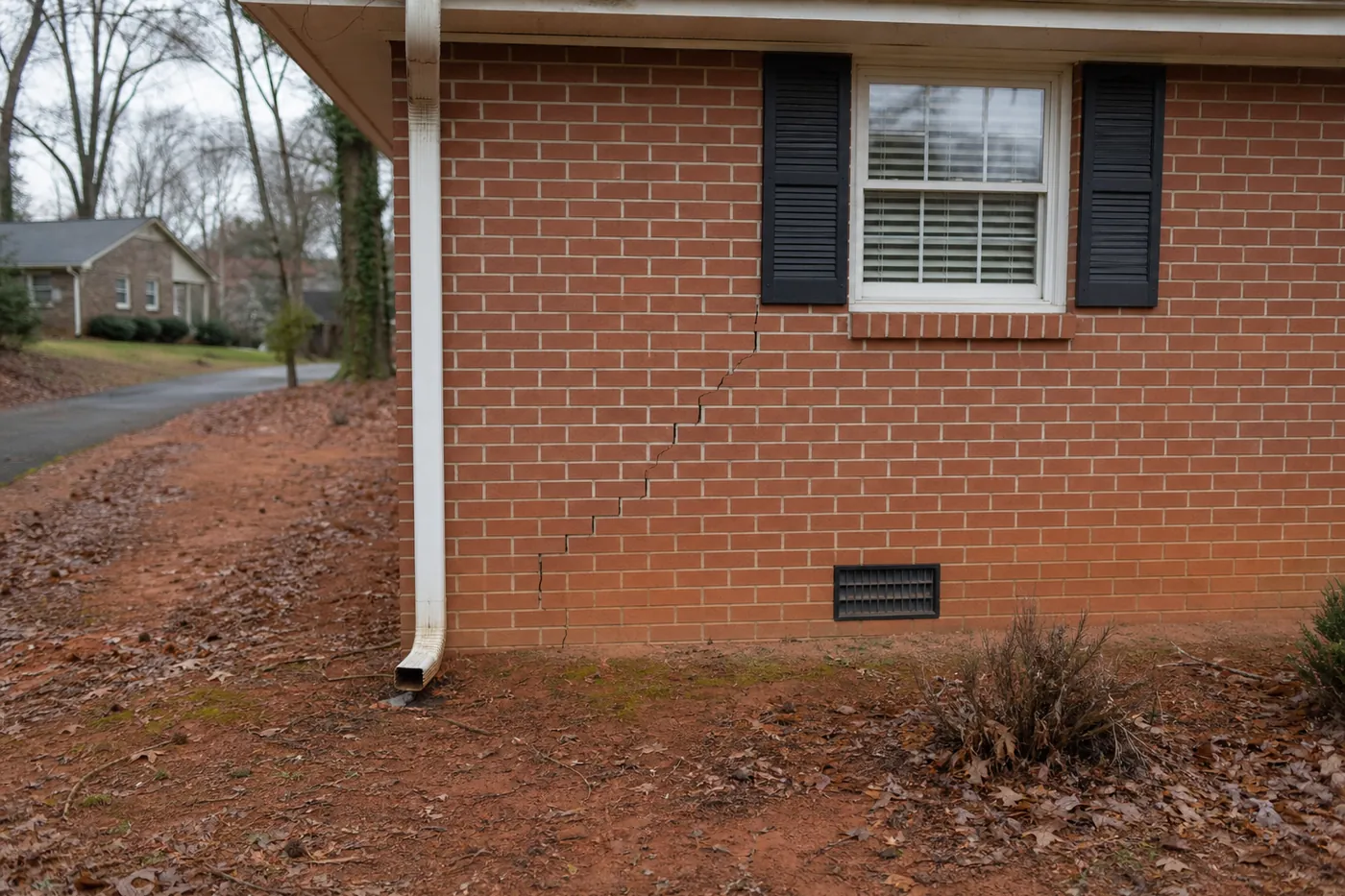
Which foundation cracks matter?
- Hairline vertical cracks in mortar or block, even width: often shrinkage. Seal and watch.
- Stair-step cracks along mortar joints, wider at one end: one side of the wall is moving down or out. Measure and date.
- Cracks from the corners of windows and doors: the opening is the weak point when a wall settles.
- Brick pulling away from the house at a corner or a chimney: worth a prompt look.
- Crumbling mortar in an older crawl space wall: age and damp. Repointing may be all it needs.
Why brick and block crack under Winston-Salem houses
Most often from water and settlement at one spot. A downspout that empties at a corner soaks the soil under that part of the footing, and the brick above cracks in steps. Footings on fill settle more than footings on firm residual clay, which USDA's soil survey describes under most of Forsyth County as well drained red clay weathered from schist, gneiss and granite. Long freezing spells are rarer than further north: NOAA's normals give about 64 nights a year at or below freezing at Smith Reynolds Airport, so frost is seldom the main driver.
How cracked brick and block are repaired
- Seal or repoint: new mortar in open joints; Fixr (2026): $200–$1,000 for a typical crack repair.
- Reset or rebuild: loose brick around a crack taken out and relaid, sometimes with ties back to the frame.
- Support the cause: if the corner is still settling, piers under the footing first, then masonry repair; otherwise the crack returns.
- Move the water: downspout extensions and grading at the cracked corner.
Watch first, then decide
Mark each end of the crack with a pencil and the date, and photograph it next to a ruler. Check again after a wet month. A crack that does not change is usually a sealing job; one that grows needs a specialist. Repointing alone is minor work, but if the repair involves the footing or other load-bearing parts, North Carolina's permit exemption no longer applies. Ranges are on the Winston-Salem foundation repair cost page.
Questions homeowners ask
Is a crack in brick veneer a structural problem?
Not by itself. Brick veneer is a skin tied to the wood frame, not what holds the house up. But veneer sits on the foundation, so a growing stair-step crack can be the first visible sign that the footing below has moved. If the crack widens, or doors nearby begin to stick, have the foundation checked.
What are the floors and walls doing?
A floor that dips, a door that will not latch, a cracked brick corner, puddles under the house: a sentence or two is enough. It goes to one independent foundation and crawl space specialist who works in Winston-Salem.