Crawl Space Repair Under Winston-Salem Floors: Piers, Girders and Joists
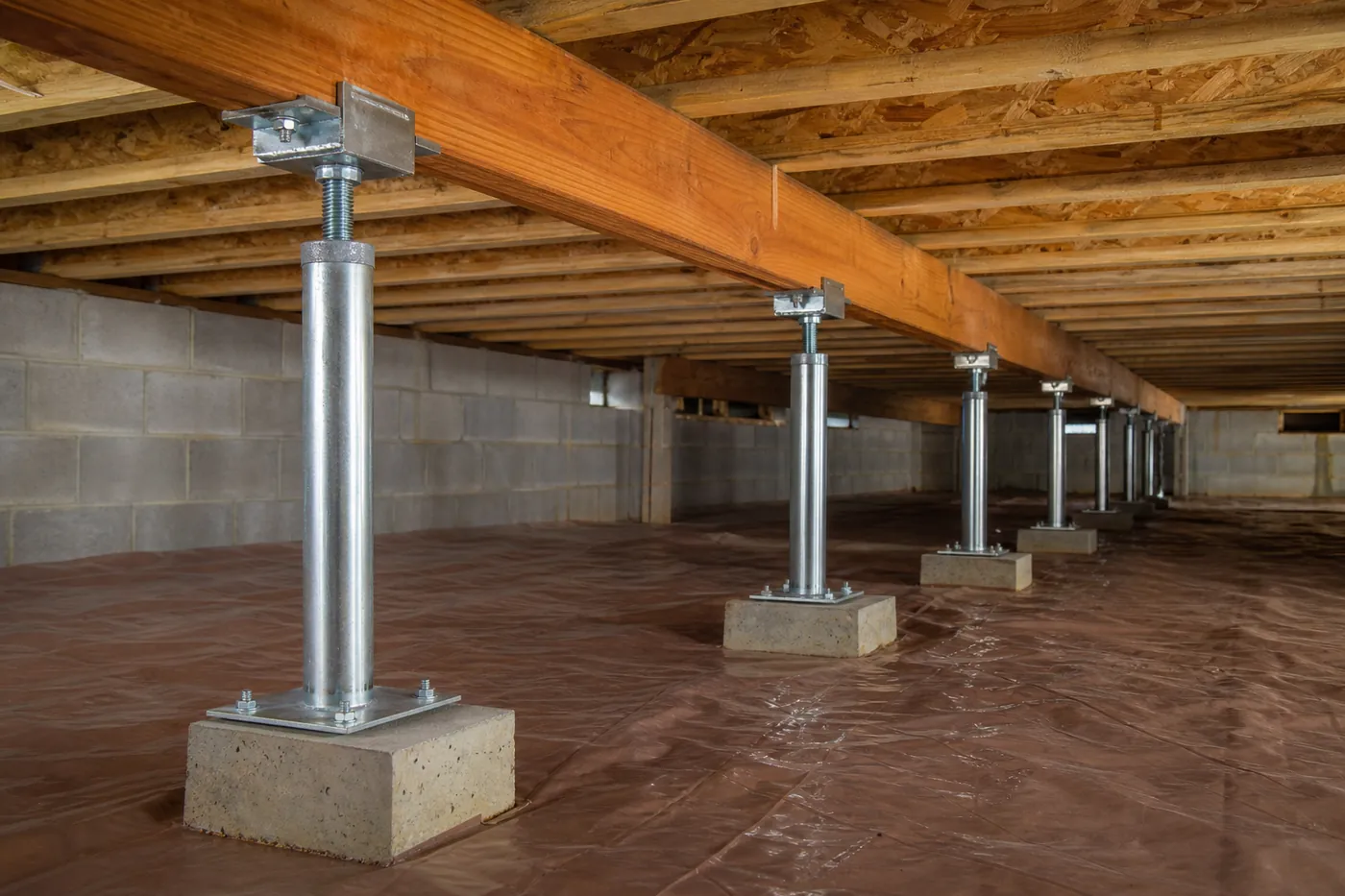
Crawl space repair in Winston-Salem usually means fixing the frame that holds the floor up. A typical crawl-space house has a masonry wall around the edge, a line of piers down the middle, a wooden girder resting on the piers and joists spanning from the girder to the walls. A sag in the floor above points to one of those parts.
Fixr (2025) puts general crawl space repair at $500–$7,500 (average $4,500), a support beam at $1,500–$5,000 and a floor joist at $100–$300. North Carolina's permit exemption for jobs of $40,000 or less does not cover load-bearing work, so pier and girder repairs normally need a permit.
What goes wrong with crawl space piers and girders?
- A pier sinks. Often it was set on a small or shallow footing, or on fill, and the soil below softened with water. The girder drops with it, and the floor dips in a line.
- A pier leans or its mortar crumbles. Old brick piers lose mortar and can tip, especially where they were never tied to a footing.
- The girder sags or rots. Long spans between piers bend over time; ends sitting on damp masonry rot.
- Joists crack or were cut. Plumbers and duct installers notch joists; a few cuts can leave a bouncy floor.
- Sill plates and rim joists soften. Where the frame sits on the outside wall, splash-back and wet soil rot the wood first.
How crawl space piers and girders are repaired
- New footing and pier: the sunken pier is removed, a properly sized concrete footing is poured, and a masonry pier or a steel post goes back on it.
- Supplemental supports: extra piers or posts shorten a girder span that has sagged.
- Girder repair or replacement: a rotted section is cut out and spliced, or the girder replaced; Fixr (2025): $1,500–$5,000 per beam.
- Joist work: sistering a new joist alongside a cracked one ($150–$325 each, Fixr 2026) or replacing it ($100–$300, Fixr 2025).
- Raising slowly: jacking a sag back up a little at a time so walls and trim above can adjust.
Shims driven between a pier and a girder can level a floor for a while; they do not fix a pier that is still sinking.
Why the wood failed matters as much as the fix
Most rot and insect damage under a house starts with water. Winston-Salem averages 43.2 inches of rain a year (NOAA, Smith Reynolds Airport), and a downspout emptying beside the foundation keeps the soil under the nearest piers wet. Ask the specialist where the moisture came from and what will keep the new wood dry; the water under the house page covers drainage. North Carolina's seller disclosure form asks about wood-destroying insects as well as the foundation, so keep the paperwork from any repair.
Permits and who does the work
Under G.S. 160D-1110, a single-family repair of $40,000 or less is exempt from a building permit unless it adds, repairs or replaces load-bearing structures. Piers, girders, joists and footings are load-bearing. In Winston-Salem and most of Forsyth County the permit comes from the City-County Inspections Division, applied for online. Ask the contractor to pull it, and compare the ranges on the Winston-Salem foundation repair cost page.
Questions homeowners ask
Can steel jack posts replace brick piers under my house?
Often they can, if they are rated for permanent use, sized for the load and set on a proper footing rather than bare soil or a thin pad. Temporary screw jacks sold for shoring are a different product. Because posts carry the house, the work counts as load-bearing, so the permit inspection is where the choice gets checked.
What are the floors and walls doing?
A floor that dips, a door that will not latch, a cracked brick corner, puddles under the house: a sentence or two is enough. It goes to one independent foundation and crawl space specialist who works in Winston-Salem.